DEVTest environment – preview of the new website. No real orders, data may be reset at any time.

Current transformers

A current transformer maps a high primary current at a fixed ratio to a small, safely measurable secondary current – typically 1 A or 5 A. We supply current transformers made in Germany: plug-on, wound, split-core, busbar retrofit and protection CTs – also verified versions. Plus MID energy meters and grid protection.

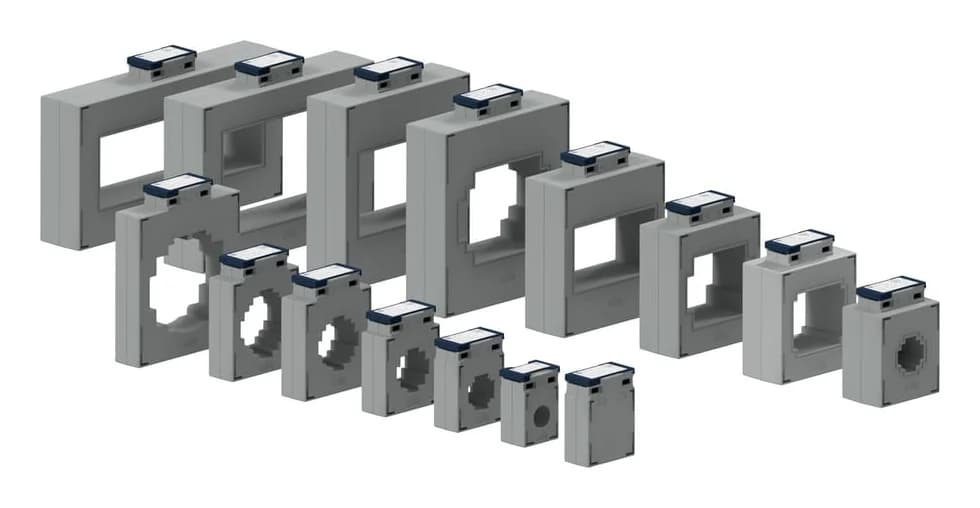
CELSA ALO plug-on current transformers, all sizes

How a current transformer works

The primary conductor – a cable or busbar – passes through the core or is connected to the primary terminals. The alternating current creates an alternating magnetic field in the core, which induces a current in the secondary winding at the transformation ratio. With a 250/5 A transformer, 5 A flow on the secondary side when 250 A flow on the primary side.

Meters, energy meters or protection relays are connected to the secondary circuit. Their consumption and the wiring form the burden that the transformer must drive with its rated output in VA. If the burden is too high, the transformer saturates and reads low.

Important in operation: the secondary circuit of a current transformer must never be left open under load – dangerous voltages would arise at the terminals. CELSA ALO transformers therefore have an integrated short-circuit bridge.

Selecting the right current transformer

Five parameters determine the choice. The transformer finder asks for them one by one and shows the matching types with aperture and outer dimensions.

  • Primary current – the rated current of the conductor, as close as possible to the actual load. A heavily oversized transformer is less accurate at partial load.
  • Secondary output – 5 A for classic instruments and short leads, 1 A for longer secondary wiring, 333 mV for energy meters and monitoring systems with voltage input.
  • Accuracy class – 0.2s, 0.5, 1 or 3. Billing and conformity-assessed metering require class 0.5 or better. Read more →
  • Rated output in VA – must cover the consumption of the devices and the losses of the secondary wiring. The VA calculator determines the demand from cable length and cross-section. Read more →
  • Conductor and space – cable diameter or busbar size define the window; mounting on DIN rail, busbar or directly on the cable.

Standards and quality

The current transformers in our range are manufactured to IEC 61869 parts 1 and 2 and DIN EN 42600 and are available in accuracy classes 0.2s, 0.5, 1 and 3. The verified plug-on transformers ALO-E and WALO-E are approved for official calibration or conformity-assessed metering.

The housing is made of self-extinguishing polycarbonate V0 to UL 94. Every type is stored as a variant with article number, datasheet and dimension drawing.

Frequently asked questions about current transformers

What does 250/5 A mean on a current transformer?

The transformation ratio: at 250 A in the primary conductor, 5 A flow in the secondary circuit. Connected instruments and meters scale back to the primary current with this ratio.

Which accuracy class do I need?

Billing-relevant and conformity-assessed metering requires class 0.5 or 0.2s with approved transformers; for pure display and monitoring tasks class 1 or 3 is usually sufficient. The class comparison shows the error limits of each class.

What is the difference between measuring and protection CTs?

Measuring transformers saturate quickly above their operating range and thus protect the connected devices. Protection transformers saturate far outside so that short-circuit currents are transmitted correctly to the protection relay.

Can I retrofit a current transformer without shutting down the system?

Yes – with split-core/cable conversion transformers (TQ, TC) or busbar retrofit transformers (IAG, IAM, IAP). The core is opened, placed around the conductor and latched again; the primary circuit stays closed.

How many VA does my current transformer need?

As much as the device consumption plus the losses of the secondary wiring add up to – and not much more, otherwise accuracy suffers. The VA calculator determines the value from cable length, cross-section and the connected devices.

Are verified current transformers available for billing?

Yes – the plug-on current transformers ALO-E and WALO-E are verified versions for billing-relevant and conformity-assessed metering, for example together with an MID energy meter. For operational metering and display, the standard versions are sufficient.

Not sure which current transformer fits? We will advise you – or let the transformer finder guide you.